

Promethium [61]: a silvery-white mantic metal. Used to produce a luminous green glowing pigment, and to amplify thought-detection.
Silmarillium [62]: a moderately hard, lustrous, silvery white mantic metal. Silmarillium is added to ceramics and glasses where it increases absorption of light. Combined with cobalt, it’s used in the production of high power magnets.
Euphorium [63]: a crystalline, silvery white, shiny mantic metal. Euphorium oxidizes to a dull yellow. Euphorium induces positive mood-altering effects.
Gandalfium [64]: a grey-white, malleable and ductile mantic metal. Gandalfium possesses unusual metallurgic properties, to the extent that as little as 1% gandalfium can significantly improve the workability and resistance to high temperature oxidation of iron, chromium, and related alloys. Used to amplify the detection of undead.
Turbinium [65]: a very hard, silvery white mantic metal. Abundant on the planet Ferrus, where sages hypothesize it could be alchemically deconstructed to produce a breathable, oxygen-rich atmosphere for the planet, and an abundance of pure lanthanum as the byproduct. Also used to detect poison.
Dysprosium [66]: a soft, shiny silver mantic metal. Name means “hard to find.” Dysprosium and holmium have the highest magnetic strengths of the elements. Dysprosium fires cannot be put out by water. Used to detect secret doors, traps, snares, etc..
Holmium [67]: a relatively soft and malleable silvery-white mantic metal. Dysprosium and holmium have the highest magnetic strengths of the elements. Holmium is one of the colorants used for cubic zirconia and glass, providing yellow or red coloring. Used to detect living creatures.
Ereborium [68]: A soft, silvery-white mantic metal. Ereborium is thought to stimulate metabolism. When added to vanadium as an alloy, ereborium lowers hardness and improves workability. Often used by Dwarven smiths.
Thaumium [69]: a soft, lustrous, silvery mantic metal. Thaumium fluoresces with a blue colour when exposed to ultraviolet light. Used in magic detection.
Yogiberrium [70]: a bright, lustrous, silver mantic metal. With a melting point of 824 °C and a boiling point of 1196 °C, yogiberrium has the smallest liquid range of all the metals. Used to find direction. “If you don’t know where you are going, you might wind up someplace else.”
Luciferium [71]: a silvery grey mantic metal. Used mainly as a catalyst in a variety of applications. Named for the “light bringer,” luciferium is mainly used to discern lies.
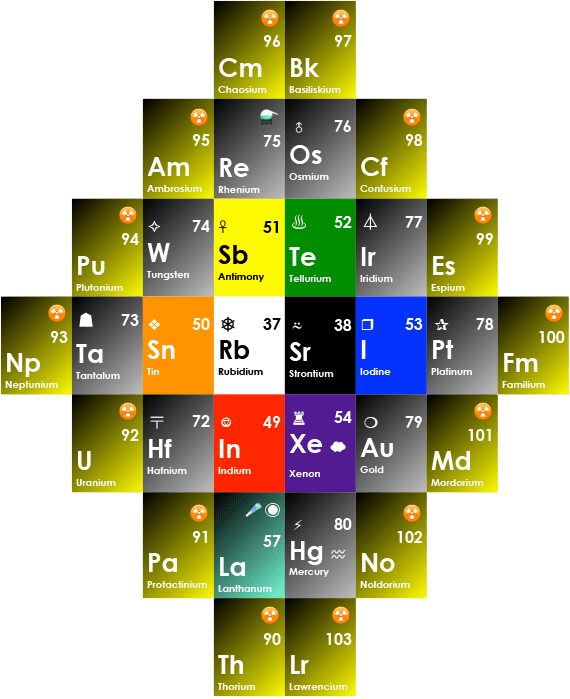
Halfnium [72]: a shiny, silver grey eccentric odic metal. Hafnium is used in alloys with iron, titanium, niobium, tantalum, and other metals.
Tantalum [73]: a very hard, blue-grey eccentric haptic metal. Highly conductive of heat and electricity, tantalum is renowned for its resistance to corrosion by acids. Tantalum’s high melting point of 3017 °C (boiling point 5458 °C) is exceeded by only four other elements.
Tungsten [74]: a hard, heavy, steel-grey eccentric chromic metal. High-density alloys of tungsten with nickel, copper or iron are used in high-quality darts, arrowheads, spearpoints, etc.. Of all metals in pure form, tungsten has the highest melting point
Rhenium [75]: a silvery-white eccentric esoteric metal. Rhenium has one of the highest melting points of all elements, exceeded by only tungsten and carbon. Used in various high temperature alloys.
Osmium [76]: a hard, shiny, bluish silver eccentric stoic metal. The densest rare element. Its alloys with platinum, iridium, and other platinum group metals are employed where extreme durability and hardness are needed.
Iridium [77]: a hard, dense, brittle, silvery white eccentric sthenic metal. Iridium is the most corrosion-resistant rare metal, even at temperatures as high as 2000 °C.
Platinum [78]: a malleable, corrosion resistant grey white eccentric majestic metal. Used high quality ornamental valuables or rarely, high-valued coins in general public circulation.
Gold [79]: a shiny yellow eccentric numismatic metal. Used for coins worth 100x the value of copper, and other luxurious gilded treasures.
Mercury [80]: a heavy, silvery white liquid eccentric frantic metal. Used in a variety of specialized thermometers, switches, and amalgams.
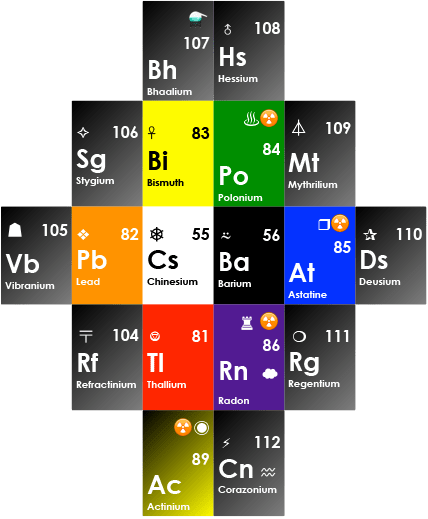
Thallium [81]: a soft, blue grey cryptic metal. Thallium and its compounds are extremely toxic, and should be handled with great care. Commonly used in rat poison and ant killer.
Lead [82]: a soft, dense, shiny, bluish silver catholic metal. Used in pigments, shielding, and numerous alloys.
Bismuth [83]: A whitish, silver-pink mephitic metal. Bismuth is used in alloys, pyrotechnics, and a variety of medical and alchemical applications.\
Polonium [84]: a heavy, silvery, vitriol-orphic metal. Polonium solutions are volatile and will evaporate within days unless sealed. Because of intense alpha radiation, a one-gram sample of polonium will spontaneously heat up to above 500 °C, generating about 140 watts of power.
Astatine [85]: a dark, lustrous, sal-orphic metalloid. Astatine confers shapeshifting qualities to some alloys.
Radon [86]: a very dense, colourless, odourless, hermet-orphic gas. Radon is not detectable by human senses alone. When frozen, radon emits a brilliant luminescence that turns from yellow to orange-red as the temperature lowers.
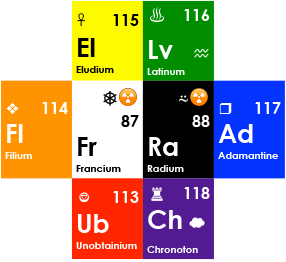
Francium [87]: an incredibly soft and heavy, shiny golden dynam-orphic metal. Produces large amounts of energy if used as a fuel source.
Radium [88]: a silvery white, errat-orphic metal. Radium, like barium, is a highly reactive metal. The naming of radium was in recognition of radium’s power of emitting energy in the form of rays.
Actinium [89]: a soft, blue-glowing, silvery white, orphic metal. Actinium has similar chemical properties to lanthanum. Used in luminous alloys.
Thorium [90]: a heavy, soft, bright silvery orphic metal. Thorium is very ductile, and tarnishes to black when exposed to air. Thorium is nearly half as dense as uranium and plutonium, but is harder than either of them. Used to create the alignmental alloy “Uru”.
 The Ages of Urthe