
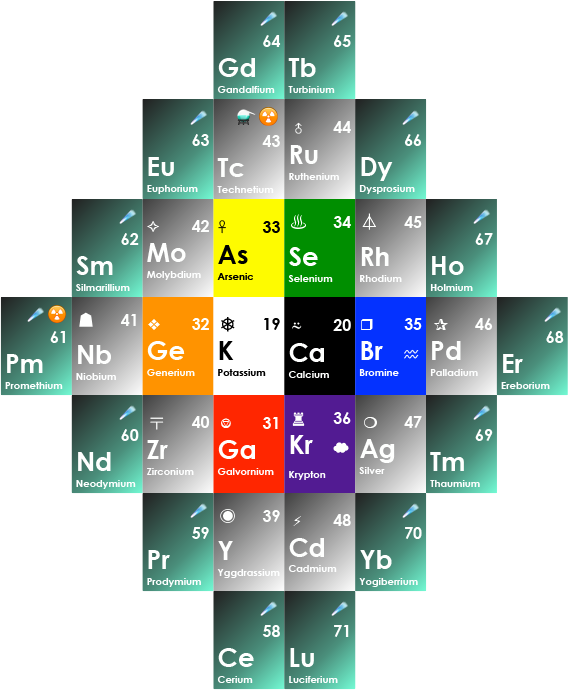
Galvornium [31]: a shiny black cryptic metal. Alignmentally toxic, strong and very malleable. Similar to alumium, but twice as hard. Sometimes called “dark iron,” galvornium is commonly used instead of iron by Dark Elven smiths (Drow-made galvornium armour does not disrupt spell casting abilities). Galvornium has a low melting point, and quickly oxidizes and becomes brittle in sunlight.
Generium [32]: a lustrous, hard, greyish white crystalline catholic metal. Used as a reagent in Animate Dead spells. Generium’s crystalline structure also makes it a useful semiconductor of arcane current, valued by artificers building enchanted mechanisms that must channel power steadily rather than in bursts. Ioun Stones of Reserve are cut from generium, its crystal lattice holding a charge exactly as it holds a spell.
Arsenic [33]: a brittle, grey metallic (or yellow, or black) mephitic solid. Yellow arsenic is soft and waxy, black arsenic is glassy and brittle. Popularly used as a poison for murdering many kinds of creatures, and, in carefully measured doses, as a hardening agent alloyed into lead shot and low-grade bronze.
Selenium [34]: an amorphous, brick-red powdered, or brittle black solid, vitriolic element. Selenium is used in some alloys, and as a red pigment in glass. Its light-sensitive conductivity is prized by artificers building simple mechanisms meant to trigger within a narrow, specific band of light intensity, too dim to fire in ordinary daylight, too bright to fire on a moonless night, sensitive to one precise threshold and no other. It is this same narrow threshold, sages now widely agree, that lies behind natural lycanthropy: a trace of selenium, scattered into Urthe’s atmosphere at the very birth of the moon, settling into the deep biology of a handful of ancient bloodlines, keyed ever since to the one exact intensity of reflected light the moon itself, at its fullest, has always cast upon the world.
Bromine [35]: a corrosive, toxic, fuming red-brown salic liquid. Bromine is used as a flame retardant, and in its poisonous gas form, as a pesticide. Sealed vials of bromine are a common component in alchemical smoke bombs meant to drive vermin and swarms from confined spaces.
Krypton [36]: a colourless, odourless hermetic gas. Used to impart a whitish glow to lighting effects. Krypton costs about 100x as much as argon, but it’s super, man. Its density and inertness also make it a preferred fill gas for pressure-sealed alchemical instruments meant to hold a stable reading over long voyages.
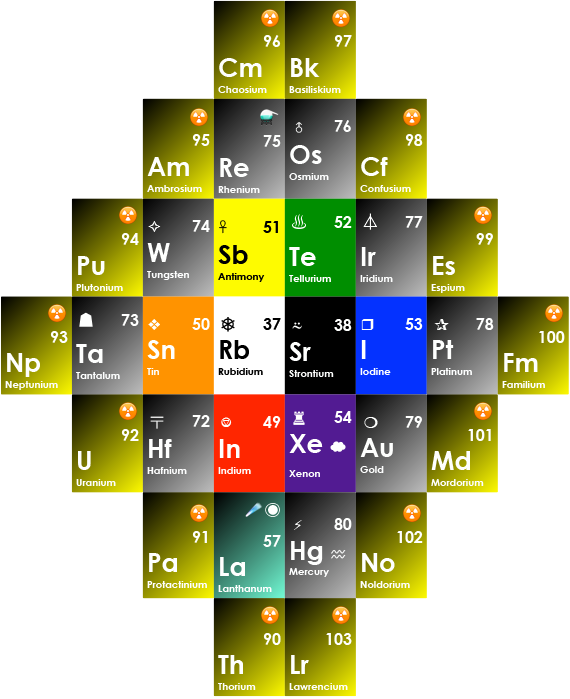
Rubidium [37]: a very soft, silvery white dynamic metal. Sometimes used to give fireworks a purple colour. Rubidium melts at just under 40 degrees celsius, warm enough that alchemists must store it in cool, sealed vessels to keep it from slumping in its container.
Strontium [38]: a yellowish, metallic, erratic element. Finely powdered strontium metal is pyrophoric: it will ignite spontaneously in air at room temperature, and give a red colour to flames, a property alchemists exploit in signal flares meant to be read at a distance.
Yggdrassium [39]: a soft, silver-metallic, lustrous and highly crystalline eccentric antic metal. Yggdrassium is found concentrated in the seeds of woody plants. It may be what tree-souls are made of, and druidic alchemists sometimes refine it from ancient heartwood as a reagent said to strengthen bonds to plant life.
Zirconium [40]: a lustrous greyish-white eccentric odic metal, notable for its extraordinary resistance to corrosion. Though relatively soft and ductile in its pure form, zirconium forms exceptionally durable compounds and is scarcely affected by acids, alkalis, salt water, or other corrosive agents. This resistance makes it highly valued in the construction of vessels, instruments, and linings intended to contain the most vitriolic alchemical reagents. Trace quantities of zirconium are incorporated into the scales, teeth, and internal linings of great dragons, granting resistance against their own caustic breath weapons and the harsh environments in which they dwell. Ioun stones of Protection are cut from zirconium.
Niobium [41]: a soft, grey, eccentric haptic metal. Niobium turns blue when oxidized. It is used in small amounts as an alloy with iron, and as it is hypoallergenic and can be anodized in many colours, niobium is used in coins and jewelry. Ioun stones of Awareness are cut from oxidized niobium.
Molybdenum [42]: a lustrous, hard, silvery-grey eccentric chromatic metal. Molybdenum has a high melting point, and is used in a variety of steel alloys, particularly those meant to hold their strength under sustained heat, such as furnace fittings and forge tools. Molybdenum leads a double life unlike any other metal on this table: in trace amounts it is genuinely essential to life itself, a required component of enzymes that fix nitrogen from the air and sustain growth in nearly every living thing, even as its refined, industrial form endures heat and stress that would destroy almost anything else. Alchemists prize it for precisely this reason, a metal equally at home nourishing the smallest seed and reinforcing the heaviest forge.
Technetium [43]: a unique, silvery grey crystalline, eccentric esoter-orphic metal. Sometimes referred to mysteriously as “Element 43”, called “The Alchemist’s Best Friend” by sages, and lovingly called “tech” by alchemists themselves, it is the most basic element required for alchemy. With a little “tech”, a good alchemist can easily turn a bit of common sulfur and a little pure calcium into… GOLD! Highly prized, and mostly mined, by Gnomes. Ioun Stones of Intellect are cut from technetium.
Ruthenium [44]: a hard, shiny, silvery white eccentric stoic metal. Ruthenium adds hardness when alloyed with palladium and platinum. It is also used as an alchemical catalyst, particularly in reactions that would otherwise require dangerously high heat to proceed at any useful rate.
Rhodium [45]: a hard, silvery white, chemically inert eccentric sthenic metal. Rhodium is highly resistant to heat and corrosion, and its inertness makes it a favored plating for reagent scales and measuring tools that must give a true reading unaffected by what they touch.
Palladium [46]: a lustrous silvery white eccentric majestic metal. Used for knightly medallions, and occasionally some coinage, palladium is a metal with low toxicity, and its capacity to absorb great volumes of hydrogen gas makes it useful in alchemical apparatus built to store or purify that element. Due to its unique properties, it could not be used to craft magical items. Dwarves prized the metal, which they called hizagkuur, and they used it for chain mail, vault doors, chest seals and locks or anything else that held items of great importance.
Silver [47]: a soft, lustrous, white eccentric numismatic metal. Used for coins (worth 10x the value of copper), mirrors, and other fine implements and items. The most electrically and thermally conductive metal, it provokes an allergic reaction in some shapeshifting creatures. Powdered fine and mixed with iron filings, silver is the traditional component consumed in wards against fiends and celestials alike, Magic Circle and Protection from Evil and Good both drawing on the same old recipe.
Cadmium [48]: a soft, bluish-grey eccentric frantic metal. Cadmium is resistant to corrosion, and is used in yellow, orange, and red pigments. Along with nickel, cadmium is also used in batteries, and alchemists handle its dust carefully, since prolonged exposure is known to weaken the lungs. Cadmium yellow remains the single most prized pigment among artisanal alchemists, a colour so pure and stable against fading that painters guard their supply jealously, even knowing the cost their lungs will eventually pay for it.
Indium [49]: a very soft, silvery white cryptic metal. Indium is used as a alloy with various metals and an indigo pigment for glassware, and its low melting point makes it a common solder for joining more delicate arcane components, where a joint must hold without ever betraying its own seam.
Tin [50]: a malleable, ductile, crystalline catholic metal. When a bar of tin is bent, a crackling sound known as the ‘tin cry’ can be heard due to the twinning of the crystals, a property some alchemists use as a crude but reliable purity test. Used in the creation of many forms of light animated construct. A properly calibrated tin tuning fork could be used to send a planar traveler to the Elemental Plane of Air.
Antimony [51]: a lustrous, silvery grey mephitic metalloid. Alloyed with lead in bullets, and used in some flame retardants, antimony is also a traditional hardening agent in pewter, lending an otherwise soft alloy enough rigidity to hold an edge or a fine casting. Dosed as a purgative, it is violent enough to be indistinguishable from poisoning.
Tellurium [52]: a brittle, mildly toxic, vitriolic metalloid. Tellurium is often alloyed with iron, lead, and copper, to improve their machinability, though smiths who work with it too long report a lingering garlic-like odour on their breath for days afterward.
Iodine [53]: a metallic, bluish black, salic solid; or a noxious violet gas. Iodine is used in solution as a disinfectant, and battlefield healers keep it among the most basic reagents in any field kit, for want of anything more refined.
Xenon [54]: a dense, colourless, odourless, hermetic gas. Used to give a bluish glow to lighting effects, for athletic doping, and as a general anaesthetic. Has uses as a propellant for ion-propulsion engines. Ioun stones of Insight are cut from crystalized xenon.
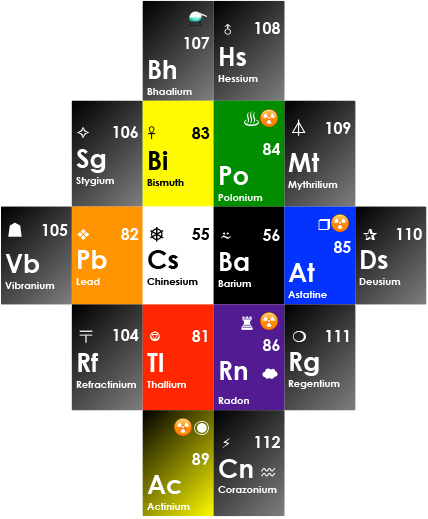
Chinesium [55]: an incredibly soft, silvery-gold dynamic metal, with a melting point of 28 degrees celsius. Chinesium is extremely reactive and pyrophoric: addition of a small amount of chinesium to cold water is explosive. Implements made from chinesium alloys may suddenly break or explode without warning.
Barium [56]: a soft, silvery grey erratic metal. Barium is used as an alloy metal, and to lend a green colour to pyrotechnics, and its salts, in more concentrated form, are dense enough to block the passage of certain probing divinations.
Lanthanum [57]: a soft, silvery white, antic, mantic metal. Lanthanum metal reacts with all the salic elements. Mischmetal, a pyrophoric alloy used in lighter flints, contains 25% to 45% lanthanum. Because Lanthanum aggressively reacts to atmospheric and chemical shifts, it is used to detect traps and hazards.
Cerium [58]: a soft, silvery, ductile mantic metal. Cerium is used in the “flint” (actually ferrocerium) of lighters. Cerium metal is highly pyrophoric, meaning that when it is ground or scratched, the resulting shavings catch fire. Used to detect invisibility.
Prodymium [59]: a soft, silvery, malleable and ductile mantic metal. Prodymium is used to create strong, durable, high-power magnets, and used to detect scrying and sensors. Prodymium makes up 5 percent of the traditional version of mischmetal.
Neodymium [60]: a soft, silvery mantic metal that quickly tarnishes in air. Neodymium is used to create strong, durable, high-power magnets, and used to detect metals and minerals. Neodymium was present in the classical mischmetal at a concentration of about 18%.

