
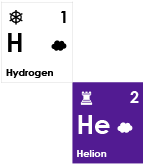
Hydrogen [1]: a colourless, odourless dynamic (“powerful”) gas. Hydrogen is the simplest and lightest element. Spawned from Elemental Water, ironically it is highly flammable, and detonates violently on contact with water elementals or other unbound water essence, making refined hydrogen a prized reagent for alchemical grenades built to counter aquatic threats. Hydrogen is used in esoteric modes of transportation, and forms the basis of the gold dragon’s fiery breath weapon.
Helion [2]: a colourless, odourless, inert hermetic (“incorruptible”) gas. Helion’s boiling and melting points are the lowest of all the elements. Spawned from Elemental Fire, ironically its total inertness makes it the standard medium for storing especially volatile reagents, sealed in helion-filled vessels to prevent premature reaction. Like Hydrogen, helion is also used in esoteric modes of transportation.
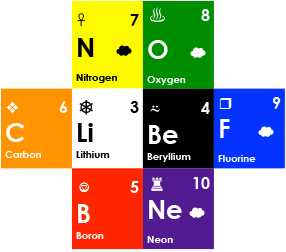
Lithium [3]: a soft, silvery-white dynamic metal. Spawned from Elemental Earth, ironically lithium is the lightest metal, and the least dense solid element. Like all dynamic elements, lithium is highly reactive and flammable, but where its siblings release their power outward, lithium’s own potency turns inward instead. Lithium compounds have long been distilled into calming elixirs, prized by monasteries and battlefield healers alike for their ability to blunt berserker rage and quiet an overwrought mind.
Beryllium [4]: a hard, lightweight, grey erratic (“unpredictable”) metal. Spawned from Elemental Air, ironically beryllium is incorporated into the famously resilient scales of dragons, and is present in emeralds and other gemstones. Its exceptional stiffness and low density contribute to the remarkable strength-to-weight ratio of draconic armour, while trace quantities impart resistance to abrasion. Beryllium is brittle at room temperature, and is an excellent sound carrier, a property put to use in far-listening horns and resonance wards. Its dust is toxic to inhale, so smiths work it only under careful ventilation. Ioun stones of Mastery are created from prisms of beryl crystal.
Boron [5]: a hard, black, cryptic (“obscure”) crystalline solid. The child of Elemental Earth and Air, boron, along with beryllium and lithium, are the rarest “basic” elements. Boron is used as a high strength refractory additive to glass and ceramics, and, ground fine and worked into lenses and mirrors, it lends those same glasses an uncanny clarity prized by scryers and diviners, who consider boron-cut glass the truest medium for far-seeing.
Carbon [6]: a catholic (“broad”) element found in various solid forms. The child of Elemental Fire and Earth. From soft, black graphite to hard, clear diamonds, and all the carbon-based life-forms of the world, that same versatility of form makes carbon the traditional base for many forms of golems or homunculi. Carbon forms the basis for the organic acids of the copper dragon’s breath weapon. Diamond, carbon’s hardest and most enduring face, carries a weight beyond the ornamental: ground fine or set whole, it is the reagent every rite of true resurrection ultimately demands, a stone incorruptible enough to anchor a soul back into flesh it has already left.
Nitrogen [7]: a colourless, odourless, mephitic (“noxious”) gas comprising the greater part of the atmosphere. The child of Elemental Fire and Air. Nitrogen forms an essential constituent of all living proteins, yet in its elemental form is remarkably inert. When compressed to enormous pressures and released through the weapon bladder of a white dragon, its rapid expansion produces a cryogenic blast capable of freezing flesh and stone alike. Converted to nitrous oxide by a brass dragon, it is expelled as a sedative gas breath weapon.
Oxygen [8]: a colourless, odourless, vitriolic (“caustic”) element. The child of Elemental Water and Air, most of the mass of living organisms is elemental oxygen. Photosynthesis releases oxygen, and respiration consumes oxygen. Oxygen’s own reactivity is essential to ordinary combustion, and alchemists who work with concentrated oxygen do so carefully, since it will feed a flame already present far beyond what open air allows.
Fluorine [9]: a highly toxic, extremely reactive yellow salic (“salty”) gas. The child of Elemental Water and Earth, fluorine is the lightest salic element, and the most electronegative element. Fluorine is added to ores to lower the melting point for smelting, and its compounds are strong enough to etch glass and metal alike, making refined fluorine acid a specialist’s tool for engraving enchantment runes into surfaces no blade could mark. Fluorinated compounds form the basis of the silver dragon’s breath weapon.
Neon [10]: a colourless, odourless, inert hermetic gas. The child of Elemental Water and Fire, neon is lighter than air, and gives a distinct, reddish orange glow to lighting effects. It is a common reagent in continual light charms where a warm, steady hue is wanted.
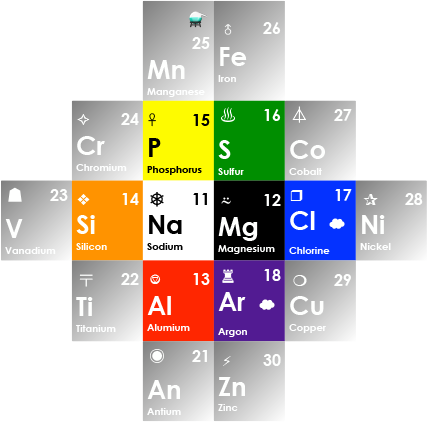
Sodium [11]: a soft, silvery-white, dynamic metal. Sodium is found in salt and lye, and sodium urate is a major crystalline component of green dragon excrement. Sodium creates a yellow flame when burned, and, like all dynamic metals, reacts violently with water, a property alchemists exploit when crafting grenades meant to punish enemies who take refuge in rivers, marshes, or the sea.
Magnesium [12]: a shiny grey erratic metal. Found in dolomite ore, pure deposits were considered extremely dangerous to encounter while mining. Along with sodium and chlorine, dissolved magnesium is abundant in seawater. Magnesium burns with a brilliant white light, and finely shaved magnesium is the standard fuel for signal flares and emergency illumination.
Alumium [13]: a soft, silvery-white, non-magnetic, cryptic metal. Alumium is lightweight and resistant to corrosion. “Magnalium” (magnesium/alumium alloy) is especially prized for its strength and light weight, and thin alumium foil, properly enchanted, is a favored backing for illusionists’ mirrors, its uncanny reflectivity said to hold a cast image longer than glass alone. Alumium is used by elves to make “glassteel,” with a complex metallurgical and alchemical process that also requires extensive knowledge of glassblowing.
Silicon [14]: a grey, crystalline, catholic mineral. A component of many sands and semi-precious stones, and used in mortars, ceramics, glass, etc. Just as carbon underlies every organic, living thing, silicon underlies every inorganic one: the true basis of many golems and stone or crystal beings. A single quartz prism, cut true, is the reagent every caster of Prismatic Spray or Prismatic Wall relies on.
Phosphorus [15]: A mephitic element occurring in white, yellow, red, violet, and black forms. Luminescent upon exposure to air and readily oxidized, certain reduced allotropes ignite spontaneously. Red dragons convert dietary phosphates into pyrophoric phosphorus compounds within their weapon bladders, producing their characteristic breath of living flame. No reagent is more common in a battle-mage’s kit: used as a material component is too many spells to list here.
Sulfur [16]: a yellow crystalline vitriolic mineral, also called brimstone. Sulfur lends strength and insolubility to keratin through sulfur-rich cross-linkages, gives many volcanic gases their characteristic rotten eggy odour, and serves as the principal precursor of sulfuric acid. Black dragons accumulate sulfur from wetlands, hydrothermal deposits, and volcanic sediments, converting it within their weapon bladders into concentrated vitriol. Like phosphorus, sulfur is a battle-mage staple: a pinch of sulfur, paired with a scrap of bat guano, is the oldest and most reliable component known for calling forth a ball of fire.
Chlorine [17]: a pale yellow-green salic gas of extraordinary oxidizing power. Chlorine has a very strong odor. Highly poisonous to most organisms, chlorine is generated by green dragons through oxidation of concentrated chloride salts within the weapon bladder and expelled as their characteristic toxic breath. Bronze dragons utilize chloride salts in their electrified aerosol breath weapon, and a faint, telltale whiff of chlorine gas, the same reaction that turns brine into bleach, lingers in the air wherever a bronze dragon’s lightning has just struck.
Argon [18]: a colourless, odourless, inert hermetic gas constituting a small but constant portion of the atmosphere. When electrically excited, argon emits a brilliant violet light and forms a stable plasma. Blue dragons continuously concentrate atmospheric argon within their weapon bladders and, by means of specialized electroplax organs, ionize and expel it as a coherent plasma bolt or “lightning breath.”
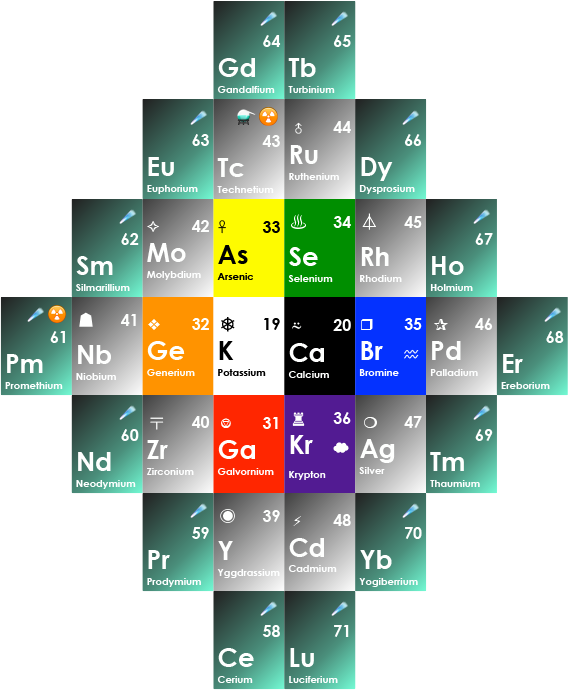
Potassium [19]: a soft, silvery dynamic element. Potassium ions are necessary for the function of all living cells. Also known as kalium. Potassium’s violent reaction with water is even more pronounced than sodium’s, burning with a characteristic lilac flame, and its salts are sometimes worked into ship-breaker charges by coastal raiders and naval alchemists.
Calcium [20]: a soft, grey erratic metal. Calcium is essential for living organisms. As a major material used in mineralization of bone, teeth and shells, calcium is the most abundant metal by mass in many animals, and its salts are the foundation of necromantic craft, ground into phylacteries, worked into the frames of bone golems, and drawn upon to knit skeletal constructs into lasting cohesion. A single statuette carved whole from bone or ivory is the traditional anchor for a Contingency spell. Red dragons, stripping phosphate from their diet to fuel their breath weapon, excrete the calcium left behind in dense, chalky deposits distinct from any other draconic waste.
Antium [21]: a silvery white eccentric antic metal. Antium can be alloyed with alumium (plus lithium, magnesium, & titanium) to create ‘Almat’: a strong, lightweight alloy “as strong as titanium, light as aluminium, and hard as ceramic”, making it a favored base metal for armor meant to be worn on long campaigns. Unalloyed, antium withstands repeated heating and cooling without cracking or warping, a property that has made it the standard core for lantern housings and forge-tools meant to be thrust in and out of open flame a thousand times over without ever once failing.
Titanium [22]: a lustrous, silvery grey-white eccentric odic metal. Low in density, high in strength, heat and corrosion resistant, titanium is alloyed with many other metals. In its unalloyed condition, titanium is as strong as some steels, but less dense, prized by smiths for armor that must be both durable and light enough for a mounted soldier or scout.
Vanadium [23]: a medium-hard, ductile, steel-blue eccentric haptic metal. Most vanadium is used as the steel-strengthening alloy, “ferrovanadium” or “Rearden Metal,” valued especially for keeping a fine edge on blades subjected to repeated heavy impact. Vanadium and chromium mark the hottest point of the whole Eccentric decade, melting points that dip sharply at manganese before iron partially recovers, and the run cools steadily onward from there to zinc’s low, soft close.
Chromium [24]: a lustrous, silvery eccentric chromatic metal. Chromium takes a high polish, and resists tarnish. Used in chrome plating, stainless steel, various pigments, etc., and its resistance to tarnish makes it a common finish for ceremonial arms and armor meant to be displayed rather than worn to war. Chromium gives rubies their characteristic red hue. Known to gnomes and elves as arandur, the blades they forged from the metal held a sharp edge even after much abuse, and their armor and shields were resistant to sonic waves.
Manganese [25]: a silvery-grey eccentric esoteric metal. Important in stainless steel and alumium alloys, manganese resembles iron, and is also used as a drying agent in inks, paints, and varnishes. Manganese is essential to life in trace amounts, yet accumulates silently with prolonged exposure, producing a slow neurological decline that smiths and miners alike have historically failed to trace back to its true cause. Ioun stones of Fortitude are cut from rhodochrosite, manganese’s own banded pink ore.
Iron [26]: a strong, malleable, magnetic, grey, eccentric stoic metal. Alloyed with < 2.1% carbon to make steel (alloying with additional elements lends the steel other related additional properties). Iron’s natural magnetism makes it the standard material for compasses and other navigational instruments. Black dragons, drawing sulfur from iron-bearing pyrite for their acid breath, leave the stripped iron behind as rust-red hematite, a telltale rusty stain marking the approach to any black dragon’s lair.
Cobalt [27]: a hard, lustrous, silver grey eccentric sthenic metal. Used as a blue pigment in ceramics, glass, and paints, cobalt is named for the kobolds who often use the material for their blue tribal markings. Cobalt alloys are prized where raw physical vigor matters most, retaining their strength under stresses and temperatures that would soften ordinary steel. Ioun stones of Strength are forged from cobalt.
Nickel [28]: a warm silvery-white, lustrous, eccentric majestic metal. Used for badges of office, and occasionally coinage, or as corrosion-resistant plating or an alloy metal. Nickel is magnetic at room temperature, and can provoke an allergic reaction. Sometimes used for the cross-guards and pommels of swords.
Copper [29]: a shiny orange eccentric numismatic metal. Used for common base coins, and some simple implements, and alloyed to make bronze and brass. Copper’s excellent conductivity also makes it the standard core material in arcane wiring and enchanted circuitry, and a single fine-drawn wire of it is the traditional focus for casting one’s voice and message across any distance, however far. A properly calibrated copper tuning fork could be used to send a planar traveler to the Elemental Plane of Fire.
Zinc [30]: a lustrous, bluish white, eccentric frantic metal. Quick to react and quick to melt, zinc is used mainly in corrosion resistant platings, and in alloys like brass and bronze, as well as in white pigments. A properly calibrated zinc tuning fork could be used to send a planar traveler to the Elemental Plane of Earth.

