
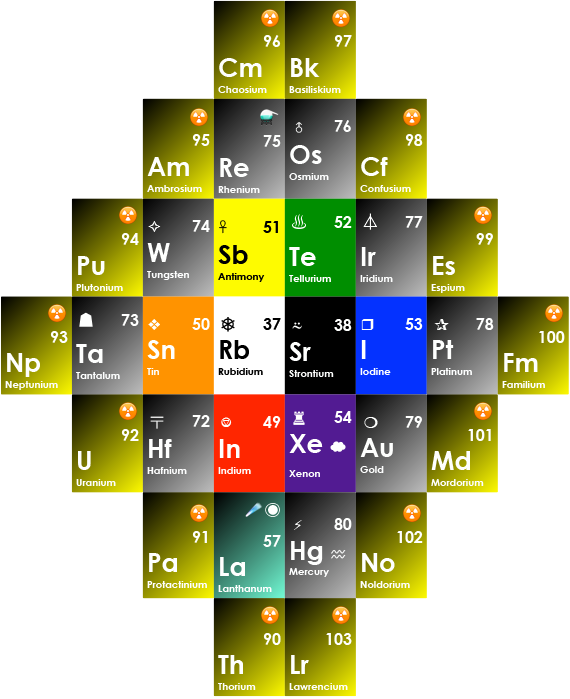
Protactinium [91]: a dense, silvery grey, toxic, orphic metal. Protactinium is more dense and rigid than thorium but is lighter than uranium, and its melting point is lower than that of thorium and higher than that of uranium. True to its name, “before actinium,” protactinium is found only in vanishingly small traces within uranium ore, itself a decay product on the long path toward actinium, making a pure sample among the rarest and most laboriously extracted substances on the entire table.
Uranium [92]: a very heavy, silvery white orphic metal. Uranium is used in energy-infused weapons and armour, in dwarven furnaces, and in the Underdark for illumination purposes. Its decay proceeds so slowly that a vein of uranium laid down when the world itself was young has still, even now, only half spent its fire, a patience longer than any dynasty, any forest, any mountain range that has risen and worn away above it.
Neptunium [93]: a hard, silvery orphic metal. Denser than uranium or plutonium both, a small ingot of it carries more true weight than iron twice its size, prized as anchor-stock and diving ballast where a vessel needs to sink true and fast. Its slow, steady decay gives off heat enough to run sealed apparatus for years without air or flame, the same quiet warmth said to drive the furnace at the heart of an Apparatus of Kwalish.
Plutonium [94]: a hard, brittle, silvery orphic metal. Used mainly in energy production, as a power and heat source, or for powerful explosives. Plutonium is restless even at rest, shifting between six distinct crystalline forms as it warms from cold storage to working heat, its density swinging wildly with each change, a metal that must be handled with as much attention to its mood as to its mass.
Ambrosium [95]: a soft, silvery white orphic metal. Used mainly as a preservative in a variety of applications, especially resistance to natural decay. Used in embalming, and in life-extension magicks. Its slow, steady radiation is gentle enough to be worked with directly, unlike its more violent orphic kin, and alchemists prize this restraint above all: a metal that holds its own decay at bay long enough to lend the same patience to whatever it preserves. Ioun stones of Regeneration are grown from ambrosium, its own slow, patient decay lent outward to whoever wears it.
Chaosium [96]: a purple-glowing, hard, dense, silvery orphic metal. Used mainly in chaos-related applications. Chaosium generates its own heat from within, radiating warmth without any external flame or fuel, a self-sustaining glow so reliable that sealed chaosium cores have powered instruments and wards in places no ordinary flame could survive, an outward stability born, paradoxically, from constant internal upheaval. Prolonged, unshielded exposure to its glow is said to fray the mind rather than the body, sages who study it too closely reporting dreams of vast, indifferent things stirring just past the edge of comprehension, a cost few consider worth the insight gained. Used in the creation of a Deck of Many Things.
Basiliskium [97]: a soft, silvery white orphic metal. A litho-kinetic material, basiliskium is mainly used to petrify other materials, turning them to stone. Its own crystal lattice shifts unpredictably between forms under pressure and temperature, as though the metal itself cannot decide what it wants to become, an instability alchemists believe is the true source of its power to force that same indecision upon whatever it touches.
Confusium [98]: a soft, malleable, silvery-white orphic metal. Used mainly as mind-scrambling agent. Confusium sheds a steady stream of neutrons, particles with no charge of their own, able to pass straight through flesh and stone alike and unsettle whatever fine structure they encounter along the way, a disruption that alchemists have learned to aim rather than merely contain.
Espium [99]: a soft, glowing, silvery white orphic metal. In addition to its glow, espium radiates heat, but damages its own structural integrity while doing so. A psychokinetic material, espium is used to confer psychic abilities. First isolated from the wreckage of a catastrophic alchemical blast, espium’s fierce self-radiation slowly disorders its own crystal structure over time, a metal that quite literally wears itself thin lending its power to the mind of whoever carries it.
Familium [100]: a very heavy, silvery-white orphic metal. Used as a catalyst in a variety of applications, especially detection of relations and familiars. Familium’s own decay proceeds through an unusually long, orderly chain of related forms before settling, one substance’s inheritance passed down through generations of itself, which sages hold is the natural root of its affinity for tracing kinship and bond in anything else.
Mordorium [101]: a very heavy, silvery-white orphic metal. Used mainly as a catalyst in a variety of applications, especially detection instruments. Fittingly for a metal so devoted to detection, mordorium was itself discovered one atom at a time, identified before enough of it had ever existed at once to see, weigh, or touch, a substance known first by pattern and prediction rather than by any direct evidence at all.
Noldorium [102]: a very heavy, silvery-white orphic metal. Used mainly as a catalyst in a variety of applications, especially detection instruments. Noldorium behaves as a heavier homolog to yogiberrium, sharing its cousin’s affinity for direction and orientation, though noldorium’s own instability means that affinity fades within moments of refinement, a compass that only ever points true for an instant.
Lawrencium [103]: a very heavy, silvery-white orphic metal. Used mainly in law-related applications. Lawrencium closes the great Orphic sequence, the final element bound by the same slow chain of decay that begins all the way back at protactinium, a fitting place for a metal alchemists invoke wherever a matter must, at last, be settled.
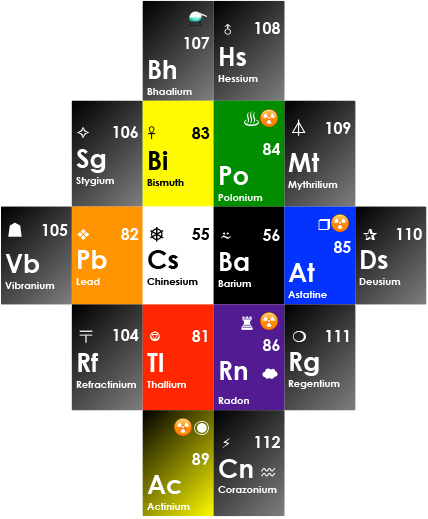
Refractinium [104]: a very heavy, silvery-grey eccentric odic metal. Extraordinarily resistant to heat and wear, refractinium is used in alloys with iron, titanium, niobium, tantalum, and other metals to forge durable weapons and armour. The irony has not escaped alchemists: the metal that lends endurance to everything it touches is itself the least enduring of all, decaying away within moments of its own refining, its permanence a gift it can give but never keep. Greater Absorption stones are cut from refractinium, absorbing what its base element only endures.
Vibranium [105]: a hard, blue-grey eccentric haptic metal. Absorbs kinetic energy to become temporarily even more hard and dense. Vibranium is renowned for its resistance to corrosion by acids. Called Cuendillar or “Heartstone” by some. True to its haptic nature, vibranium answers touch in kind, a light tap passes through it unchanged, but a heavy blow is met with equal resistance, as though the metal itself were listening and replying rather than simply absorbing force.
Stygium [106]: a hard, heavy, blue-black eccentric chromatic metal. Crystalline in nature, with refractive qualities that are used in cloaking or invisibility applications. High-density alloys of stygium are used in high-quality darts, arrowheads, etc. Its crystal lattice bends light so thoroughly that a thin enough sheet of stygium appears to swallow it outright, giving the metal its name and its long association with the deepest, lightless reaches of the Underdark, where it was first mined by those who valued its darkness as much as its edge.
Bhaalium [107]: a heavy, silvery-white, highly corrosion-resistant eccentric esoteric metal. Used in exotic alloys. A highly toxic element, wounds inflicted by bhaalium weapons are notoriously difficult to heal. Used to create “Baatorian Green Steel.” Its toxicity works at the cellular level rather than the merely chemical, disrupting the body’s own capacity to knit itself back together, which is why a bhaalium wound lingers long after the blade that caused it has been cleaned and sheathed. Used to create a Nine-Lives Stealer blade.
Hessium [108]: a hard, shiny, bluish silver eccentric stoic metal. Its alloys with platinum, iridium, and other platinum group metals are employed where extreme durability and hardness are needed. The densest element, and subtly luminescent, hessium can be alloyed and forged into delicately wrought “Hessian” blades of exceptional lasting sharpness. Used in the creation of Vorpal blades and “Valyrian Steel”.
Mythrilium [109]: a hard, very dense, silvery white, corrosion resistant eccentric sthenic metal. Famously alloyed and wrought into fine, strong, lightweight armour. Also used to create beskar, or “Mandalorian Iron”. Its density and strength seem to belong to two different metals entirely, dense enough to stop a blade outright, yet light enough that armour forged whole from it weighs less than the leather it replaces.
Deusium [110]: a glowing, moon-white, corrosion-resistant eccentric majestic metal. Also called “holy silver,” this element is used in restorative or curative magic. Like the platinum-group metals it shares its column with, deusium acts as a catalyst rather than a consumable, present at the working of a cure without being spent by it, a single vial capable of purifying draught after draught long after lesser reagents would have been used up entirely. Used in the creation of a ‘Holy Avenger’, or elvish ‘Moonblade’, or any blessed weapon needing a divine, curative charge behind it.
Regentium [111]: a glowing, sunshine-yellow, corrosion-resistant eccentric numismatic metal. Also called “imperial gold,” this element is worth 100x its weight in gold. It is rumoured that regentium coins exist, and are traded only among the world elite. Used in medicinal magic. Called “orichalcum” when alloyed with copper. Used in the creation of a “Sun Blade” of similar radiant weaponry.
Corazonium [112]: a glowing, deep red, viscous, eccentric frantic metal. Liquid at room temperature, and incredibly volatile, corazonium is used in pyrotechnics and other serious explosions. Also known as “Urthe-blood” or “Red Mercury,” its glow is its own warning: corazonium radiates visible heat even at rest. A major component of Thrym extract. Used in the creation of ‘flame tongue’ weaponry and Githyanki Silver Swords.
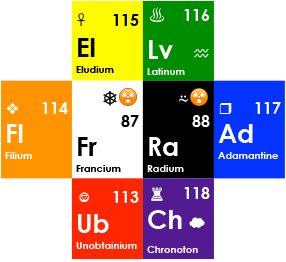
Unobtainium [113]: a soft, blue-black, malleable cryptic metal. Every known deposit traces back to fallen star-metal, meteoric ore that struck the world from elsewhere. Toxic to the touch, but stable in sunlight, unobtainium is stronger than galvornium, and smiths who manage to work a piece at all treat it as a singular, unrepeatable event rather than a supply.
Filium [114]: a soft, pink catholic metal, disturbingly similar to flesh in both appearance and texture. Affectionately called “the philosopher’s child” by alchemists, filium is used in the creation of artificial organs, golems, homunculi, and other constructed beings, and Githyanki Silver Swords.
Eludium [115]: A whitish, silver-pink mephitic metal. Used in anti-gravitational, inter-dimensional, and inter-planar travel. True to its name, eludium has never been directly observed, only inferred: no alchemist has isolated a sample, weighed it, or held it in hand, and its existence is known solely through the anomalous, reality-bending effects attributed to it, a metal proven entirely by its consequences and never once by itself. Used to create Bags of Holding, Portable Holes, and Githyanki Silver Swords.
Latinum [116]: a silvery, viscous, vitriolic metal. Liquid at room temperature, latinum cannot be replicated through any known alchemical means. Called in folklore “the elixir of life” or “livermorium,” it is renowned for its healing properties, though never a gentle cure: disease and infirmity are scoured from within. Used to create a Ring of Sustenance or a Potion of Longevity. Ioun Stones of Sustenance are grown from latinum.
Adamantine [117]: an iridescent black salic metal. Exceedingly hard, and almost impossible to smith. The most legendary of all metals, it resists all corrosion, and resists being alloyed with lesser metals. A number of arcane spells consumed adamantine as a material component.
Chronoton [118]: a super-dense, silvery-white, odourless hermetic gas. Chronoton fills the Astral Plane, and the intense density of chronoton warps the temporal dimension. Chronoton cannot be compressed by any ordinary means, resisting pressure the way an inert gas resists reaction, and alchemists take this as confirmation that its density is not a property of mass in the usual sense at all, but a measure of how much duration has been folded into so small a space.
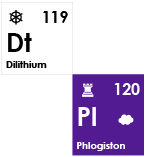
Dilithium [119]: a lavender-pinkish, crystalline dynamic metal. Useful in massive energy production, and in resurrectional magic. Struck or heated, dilithium does not simply release energy, it returns more than was put into it, a net gain alchemists still argue over. Alchemists who handle it in bulk keep their forges well clear of open flame, since a struck vein of dilithium, once its resonance begins, cannot easily be stopped, only spent.
Phlogiston [120]: a super-dense, opaque, brilliant, multicoloured hermetic gas. Phlogiston (called ‘Phlo’ for short) fills the void between worlds, between stars. Its own weight binds it tighter than any lesser element, sealing it hermetic in the truest sense, resistant to nearly every reaction matter can offer, yet that very tightness leaves any bond it’s forced into unstable beyond reckoning. Inert to everything except fire, and absolute the moment fire finds it, phlogiston is the reason no spelljammer risks carrying an open flame.

