
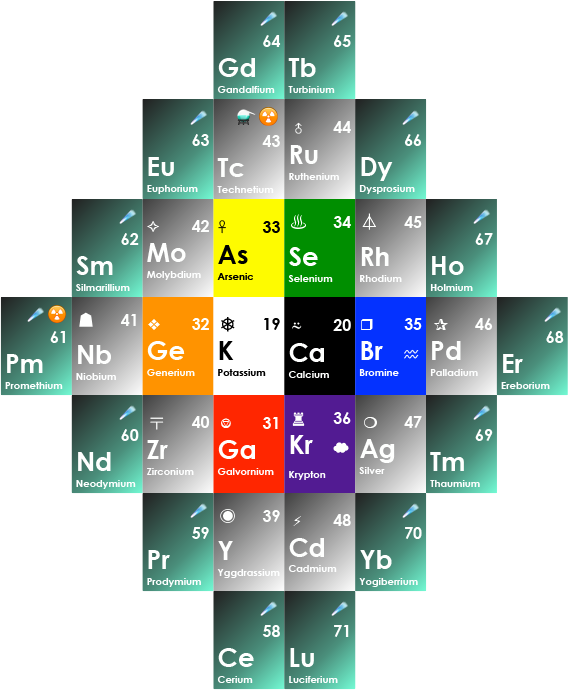
Promethium [61]: a silvery-white mantic metal. Used to produce a luminous green glowing pigment, and to amplify thought-detection. Its faint natural warmth, a byproduct of its own slow decay, makes it a favored core for alchemical hand-warmers carried on long winter expeditions.
Silmarillium [62]: a moderately hard, lustrous, silvery white mantic metal. Silmarillium aids alignment detection, and is added to ceramics and glasses where it increases absorption of light. Combined with cobalt, it’s used in the production of high power magnets.
Euphorium [63]: a crystalline, silvery white, shiny mantic metal. Euphorium oxidizes to a dull yellow. Euphorium induces positive mood-altering effects, and is used in the detection of illusions.
Gandalfium [64]: a grey-white, malleable and ductile mantic metal. Gandalfium possesses unusual metallurgic properties, to the extent that as little as 1% gandalfium can significantly improve the workability and resistance to high temperature oxidation of iron, chromium, and related alloys. Used to amplify the detection of undead.
Turbinium [65]: a very hard, silvery white mantic metal. Abundant on the planet Ferrus, where sages hypothesize it could be alchemically deconstructed to produce a breathable, oxygen-rich atmosphere for the planet, and an abundance of pure lanthanum as the byproduct. Also used to detect poison and disease.
Dysprosium [66]: a soft, shiny silver mantic metal. Name means “hard to find.” Dysprosium and holmium have the highest magnetic strengths of the elements. Dysprosium fires cannot be put out by water. Used to detect secret doors.
Holmium [67]: a relatively soft and malleable silvery-white mantic metal. Dysprosium and holmium have the highest magnetic strengths of the elements. Holmium is one of the colorants used for cubic zirconia and glass, providing yellow or red coloring. Used to detect living creatures.
Ereborium [68]: A soft, silvery-white mantic metal. Ereborium is thought to stimulate metabolism, and is used in the detection of curses. When added to vanadium as an alloy, ereborium lowers hardness and improves workability. Often used by Dwarven smiths.
Thaumium [69]: a soft, lustrous, silvery mantic metal. Thaumium fluoresces with a blue colour when exposed to ultraviolet light. Used in magic detection.
Yogiberrium [70]: a bright, lustrous, silver mantic metal. With a melting point of 824 °C and a boiling point of 1196 °C, yogiberrium has the smallest liquid range of all the metals. Used to find direction. “If you don’t know where you are going, you might wind up someplace else.”
Luciferium [71]: a silvery grey mantic metal. Used as a catalyst in a variety of applications. Luciferium is the hardest and densest metal in the mantic family, and its stability under heat and pressure makes it the standard catalyst in truth-detecting reagents, since a substance that won’t itself be altered by the reaction is what allows the enlightening reaction to occur.
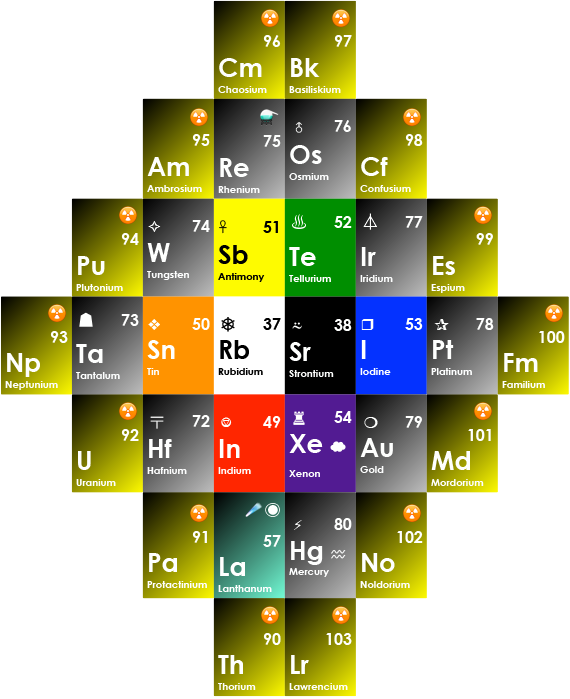
Hafnium [72]: a shiny, silver grey eccentric odic metal. Hafnium is used in alloys with iron, titanium, niobium, tantalum, and other metals, and its exceptional ability to absorb neutrons makes refined hafnium a prized reagent in protection wards meant to create a ‘haven’ from harmful radiant or alignmental energy. Ioun stones of Absorption are worked from refined hafnium, its neutron-swallowing nature turned to canceling spells instead.
Tantalum [73]: a very hard, blue-grey eccentric haptic metal. Highly conductive of heat and electricity, tantalum is renowned for its resistance to corrosion by acids. Tantalum’s high melting point of 3017 °C (boiling point 5458 °C) is exceeded by only four other elements. Raw tantalumite, marbled pink and green in its natural ore form, is polished into a perfect sphere and enchanted to create an Ioun Stone of Leadership.
Tungsten [74]: a hard, heavy, steel-grey eccentric chromatic metal. Called “whitesteel” by some, tungsten has the highest melting point of all metals in its pure form. Known to be used in the creation of magic rings. High-density alloys of tungsten with nickel, copper or iron are used in high-quality darts, arrowheads, spearpoints, etc.
Rhenium [75]: a silvery-white eccentric esoteric metal. Rhenium has one of the highest melting points of all elements, exceeded by only tungsten. Used in various high temperature alloys, rhenium was also among the last stable elements discovered, its properties a mystery for longer than almost any other metal on this table.
Osmium [76]: a hard, shiny, bluish silver eccentric stoic metal. The densest element. Its alloys with platinum, iridium, and other platinum group metals are employed where extreme durability and hardness are needed. The metal oxidizes readily in open air to form osmium tetroxide, a volatile, sharply scented compound as toxic to breathe as the pure metal is inert to touch, a caution alchemists learn early: osmium’s own hardness offers no protection against what it becomes the moment it’s exposed.
Iridium [77]: a hard, dense, brittle, silvery white eccentric sthenic metal. Iridium is the most corrosion-resistant rare metal, even at temperatures as high as 2000 °C, untouched by acids that dissolve nearly everything else on this table. A thin, worldwide layer of iridium found buried in the rock records the exact moment a falling star ended an age, undisturbed and unreactive across however many years have passed since it settled.
Platinum [78]: a malleable, corrosion resistant grey white eccentric majestic metal. Used for high quality ornamental valuables or rarely, high-valued coins in general public circulation, and its resistance to nearly all forms of chemical attack makes it the preferred crucible material for the most caustic alchemical reactions. A pair of platinum rings, worn rather than spent, is the traditional component for Warding Bond, the metal’s own incorruptibility standing in for the bond’s promise to hold. Armor crafted from platinum can provide the wearer with cold and sonic resistance.
Gold [79]: a shiny yellow eccentric numismatic metal. Used for coins worth 100x the value of copper, and other luxurious gilded treasures, and its extreme malleability allows it to be beaten into leaf thin enough to gild an entire temple ceiling from a single ingot. Fine gold dust, rather than the coin or leaf, is the traditional component for sealing a portal shut with Arcane Lock, a use jealously guarded by locksmiths who’d rather not see their trade undercut by wizardry.
Mercury [80]: a heavy, silvery white liquid eccentric frantic metal. Refined from cinnabar, it is used in a variety of specialized thermometers, switches, and amalgams, and a single drop of it is the traditional component for Tenser’s Floating Disc, mercury’s own restless, ever-shifting nature lending itself naturally to a platform that never quite sits still. Ioun stones of Agility are cast from mercury drawn straight from raw cinnabar, quicksilver given true and lasting form.
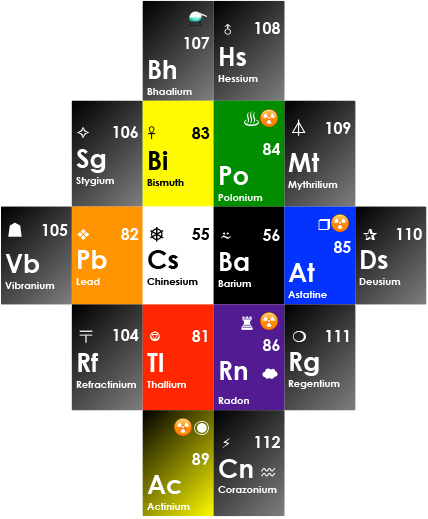
Thallium [81]: a soft, blue grey cryptic metal. Thallium and its compounds are extremely toxic, and should be handled with great care. Commonly used in rat poison and ant killer, and favoured by discreet poisoners: thallium’s effects are slow, tasteless, and notoriously difficult to trace back to their source.
Lead [82]: a soft, dense, shiny, bluish silver catholic metal. Used in pigments, shielding, and numerous alloys, its density making it the standard core material for sling bullets and ballast weights alike. Lead can block divination spells, and ground into ink, it is the required component for Illusory Script, its own weight and opacity carrying over into the words it writes, hidden from any eye the scribe didn’t intend. A properly calibrated lead tuning fork could be used to send a planar traveler to the Elemental Plane of Water.
Bismuth [83]: a whitish, silver-pink mephitic metal. Bismuth is used in alloys, pyrotechnics, and a variety of medical and alchemical applications. Alone among the mephitic family, bismuth carries almost none of its kin’s toxicity, a genuine anomaly alchemists have never fully explained. Grown slowly and cooled with care, its crystals form brilliant stairstep spirals shot through with an iridescent rainbow oxide, the single most beautiful formation any base metal on this table produces, and it is one of the rare metals that expands, rather than shrinks, as it solidifies, a contradiction of ordinary metallurgy alchemists have long prized for casting fine detail that never shrinks away from the mould.
Polonium [84]: a heavy, silvery, vitriol-orphic metal. Polonium solutions are volatile and will evaporate within days unless sealed. Because of intense alpha radiation, a one-gram sample of polonium will spontaneously heat up to above 500 °C, generating about 140 watts of power. Its danger lies entirely in scale rather than in force: a quantity too small to see or taste is more than enough to kill slowly, over days, with no wound and no warning, which has made polonium the quiet favourite of poisoners patient enough to let a court’s own physicians rule the death natural.
Astatine [85]: a dark, lustrous, sal-orphic metalloid. Astatine confers shapeshifting qualities to some alloys. No alchemist living has seen a true sample of pure astatine, only its fleeting traces and the strange, half-understood effects those traces leave behind, which is why its alloys are prized for shapeshifting in the first place: a substance that cannot hold its own form for long lends that same instability to whatever it touches.
Radon [86]: a very dense, colourless, odourless, hermet-orphic gas. Radon is not detectable by human senses alone. As a decay product of radium, radon seeps naturally from certain stone and soil, gathering unseen in poorly ventilated cellars and mineshafts. When frozen, radon emits a brilliant luminescence that turns from yellow to orange-red as the temperature lowers.
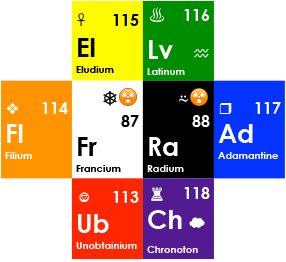
Francium [87]: an incredibly soft and heavy, shiny golden dynam-orphic metal. Produces large amounts of energy if used as a fuel source. Francium is nearly as fleeting as astatine, decaying away almost as quickly as it can be refined, so that any sample large enough to see or handle has already lost much of its potency before an alchemist can put it to use.
Radium [88]: a silvery white, errat-orphic metal. Radium, like barium, is a highly reactive metal. The naming of radium was in recognition of radium’s power of emitting energy in the form of rays. Unlike its more fleeting orphic kin, radium’s decay proceeds slowly enough to be worked with directly, and it glows with a faint, persistent light of its own in darkness, a property early alchemists prized before they understood the toll such handling took: radium’s warmth is patient, but it does not forgive prolonged closeness.
Actinium [89]: a soft, blue-glowing, silvery white, orphic metal. Actinium has similar chemical properties to lanthanum. Used in luminous alloys, actinium’s glow is stronger, blue-white against radium’s fainter light, radiant enough that a single gram will illuminate a room in perpetual twilight. Used in many glowing magical items.
Thorium [90]: a heavy, soft, bright silvery orphic metal. Thorium is very ductile, and tarnishes to black when exposed to air. Thorium is roughly three-fifths as dense as uranium and plutonium, and considerably softer than either, its workability prized where a heavy but malleable metal is required. Used to create the alignmental alloy “Uru”.

