

Galvornium [31]: a shiny black cryptic metal. Alignmentally toxic, strong and very malleable. Similar to alumium, but twice as hard. Sometimes called “dark iron,” galvornium is commonly used instead of iron by Dark Elven smiths (Drow-made galvornium armour does not disrupt spell casting abilities). Galvornium has a low melting point, and quickly oxidizes and becomes brittle in sunlight.
Generium [32]: a lustrous, hard, greyish white crystalline catholic metal. Used as a reagent in Animate Dead spells.
Arsenic [33]: a brittle, grey metallic (or yellow, or black) mephitic solid. Yellow arsenic is soft and waxy, black arsenic is glassy and brittle. Popularly used as a poison for murdering many kinds of creatures.
Selenium [34]: an amorphous, brick-red powdered, or brittle black solid, vitriolic element. Selenium is used in some alloys, and as a red pigment in glass. Probably doesn’t induce lycanthropy, but it might.
Bromine [35]: a corrosive, toxic, fuming red-brown salic liquid. Bromine is used as a flame retardant, and in its poisonous gas form, as a pesticide.
Krypton [36]: a colourless, odourless hermetic gas. Used to impart a whitish glow to lighting effects. Krypton costs about 100x as much as argon, but it’s super, man.
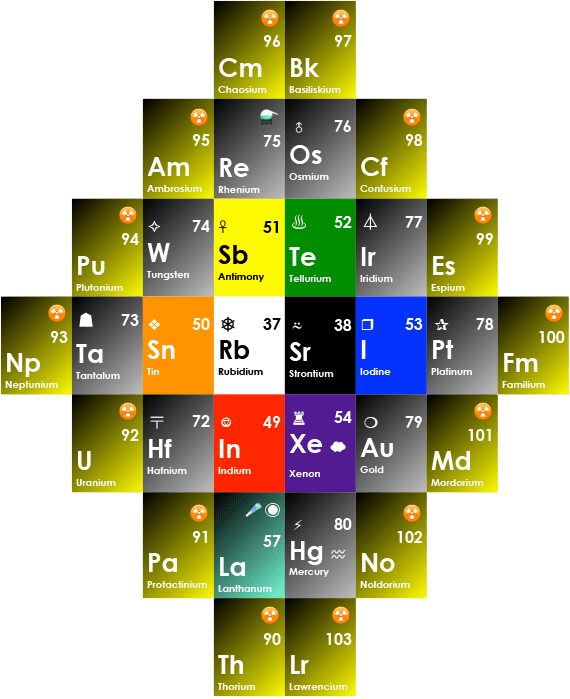
Rubidium [37]: a very soft, silvery white dynamic metal. Sometimes used to give fireworks a purple colour. Rubidium melts at just under 40 degrees celsius.
Strontium [38]: a yellowish, metallic, erratic element. Finely powdered strontium metal is pyrophoric: it will ignite spontaneously in air at room temperature, and give a red colour to flames.
Yggdrassium [39]: a soft, silver-metallic, lustrous and highly crystalline eccentric antic metal. Yggdrassium is found concentrated in the seeds of woody plants. It may be what tree-souls are made of.
Zirconium [40]: a lustrous, greyish-white, soft, ductile and malleable eccentric odic metal. In powder form, zirconium is highly flammable. Zirconium is highly resistant to corrosion by alkalis, acids, salt water and other agents.
Niobium [41]: a soft, grey, eccentric haptic metal. Niobium turns blue when oxidized. It is used in small amounts as an alloy with iron, and as it is hypoallergenic and can be anodized in many colours, niobium is used in coins and jewelry.
Molybdenum [42]: a lustrous, hard, silvery-grey eccentric chromatic metal. Molybdenum has a high melting point, and is used in a variety of steel alloys.
Technetium [43]: a unique, silvery grey crystalline, eccentric esoter-orphic metal. Sometimes referred to mysteriously as “Element 43”, called “The Alchemist’s Best Friend” by sages, and lovingly called “tech” by alchemists themselves, it is the most basic element required for alchemy. With a little “tech”, a good alchemist can easily turn a bit of common sulfur and a little pure calcium into… GOLD! Highly prized, and mostly mined, by Gnomes.
Ruthenium [44]: a hard, shiny, silvery white eccentric stoic metal. Ruthenium adds hardness when alloyed with palladium and platinum. It is also used as an alchemical catalyst.
Rhodium [45]: a hard, silvery white, chemically inert eccentric sthenic metal. Rhodium is highly resistant to heat and corrosion.
Palladium [46]: a lustrous silvery white eccentric majestic metal. Used for knightly medallions, and occasionally some coinage, palladium is a metal with low toxicity.
Silver [47]: a soft, lustrous, white eccentric numismatic metal. Used for coins (worth 10x the value of copper), mirrors, and other fine implements and items. The most electrically and thermally conductive metal, it provokes an allergic reaction in some shapeshifting creatures.
Cadmium [48]: a soft, bluish-grey eccentric frantic metal. Cadmium is resistant to corrosion, and is used in yellow, orange, and red pigments. Along with nickel, cadmium is also used in batteries.
Indium [49]: a very soft, silvery white cryptic metal. Indium is used as a alloy with various metals and an indigo pigment for glassware.
Tin [50]: a malleable, ductile, crystalline catholic metal. When a bar of tin is bent, a crackling sound known as the ‘tin cry’ can be heard due to the twinning of the crystals.
Antimony [51]: a lustrous, silvery grey mephitic metalloid. Alloyed with lead in bullets, and used in some flame retardants.
Tellurium [52]: a brittle, mildly toxic, vitriolic metalloid. Tellurium is often alloyed with iron, lead, and copper, to improve their machinability.
Iodine [53]: a metallic, bluish black, salic solid; or a noxious violet gas. Iodine is used in solution as a disinfectant.
Xenon [54]: a dense, colourless, odourless, hermetic gas. Used to give a bluish glow to lighting effects, for athletic doping, and as a general anaesthetic. Has uses as a propellant for ion-propulsion engines.
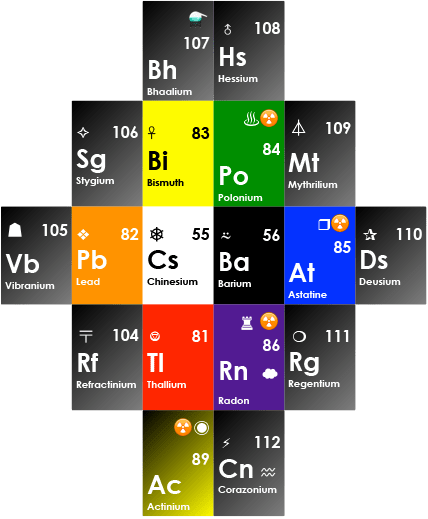
Chinesium [55]: an incredibly soft, silvery-gold dynamic metal, with a melting point of 28 degrees celsius. chinesium is extremely reactive and pyrophoric: addition of a small amount of chinesium to cold water is explosive. Implements made from chinesium alloys may suddenly break or explode without warning.
Barium [56]: a soft, silvery grey erratic metal. Barium is used as an alloy metal, and to lend a green colour to pyrotechnics.
Lanthanum [57]: a soft, silvery white, antic, mantic metal. Lanthanum metal reacts with all the salic elements. Mischmetal, a pyrophoric alloy used in lighter flints, contains 25% to 45% lanthanum.
Cerium [58]: a soft, silvery, ductile mantic metal. Cerium is used in the “flint” (actually ferrocerium) of lighters. Cerium metal is highly pyrophoric, meaning that when it is ground or scratched, the resulting shavings catch fire.
Prodymium [59]: a soft, silvery, malleable and ductile mantic metal. Prodymium is used to create strong, durable, high-power magnets. Prodymium makes up 5 percent of the traditional version of mischmetal.
Neodymium [60]: a soft, silvery mantic metal that quickly tarnishes in air. Neodymium is used to create strong, durable, high-power magnets. Neodymium was present in the classical mischmetal at a concentration of about 18%.
 The Ages of Urthe