
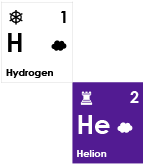
Hydrogen [1]: a colourless, odourless dynamic (“powerful”) gas. The simplest and lightest element, hydrogen is highly flammable.
Helion [2]: a colourless, odourless, inert hermetic (“incorruptible”) gas. Helion’s boiling and melting points are the lowest of all the elements.
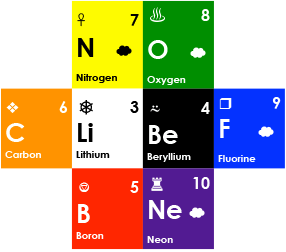
Lithium [3]: a soft, silvery-white dynamic metal. Lithium is the lightest metal, and the least dense solid element. Like all dynamic elements, lithium is highly reactive and flammable. Lithium compounds can have mood-altering effects.
Beryllium [4]: a hard, lightweight, grey erratic (“unpredictable”) metal, present in emeralds and related gemstones, and the scale of dragons. Beryllium is brittle at room temperature, and is an excellent sound carrier.
Boron [5]: a hard, black, cryptic (“obscure”) crystalline solid. Boron, along with beryllium and lithium, are the rarest “basic” elements. Boron is used as a high strength refractory additive to glass and ceramics.
Carbon [6]: a catholic (“broad”) element found in various solid forms; from soft, black graphite to hard, clear diamonds… and all the carbon-based life-forms of the world.
Nitrogen [7]: a colourless, odourless mephitic (“noxious”) gas. Nitrogen occurs in the proteins of all living organisms, and makes up most of the atmosphere. Nitrogen is notable for the wide range of explosively unstable compounds it can produce. Exhaled in its pure form as the breath weapon of the white dragon.
Oxygen [8]: a colourless, odourless, vitriolic (“caustic”) element. Photosynthesis releases oxygen, and respiration consumes oxygen. Most of the mass of living organisms is elemental oxygen.
Fluorine [9]: a highly toxic, extremely reactive yellow salic (“salty”) gas. The lightest salic element, and the most electronegative element. Fluorine is added to ores to lower the melting point for smelting.
Neon [10]: a colourless, odourless, inert hermetic gas. Neon is lighter than air, and gives a distinct, reddish orange glow to lighting effects.
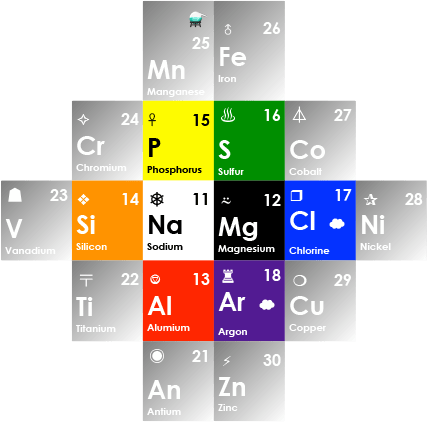
Sodium [11]: a soft, silvery-white, dynamic metal. Sodium is found in salt and lye, and is a major component of green dragon excrement. Sodium creates a yellow flame when burned.
Magnesium [12]: a shiny grey erratic metal. Along with sodium and chlorine, dissolved magnesium is abundant in seawater. Magnesium burns with a brilliant white light.
Alumium [13]: a soft, silvery-white, non-magnetic, cryptic metal. Alumium is lightweight and resistant to corrosion. “Magnalium” (magnesium/alumium alloy) is especially prized for its strength and light weight.
Silicon [14]: a grey, crystalline, catholic mineral. A component of many sands and semi-precious stones, and used in mortars, ceramics, glass, etc..
Phosphorus [15]: a mephitic element of varied forms, from whitish, to yellow, to red, to black. Luminescent in oxygen, and highly flammable, even self-igniting, an exhalation of phosphorus produces the flame of a red dragon’s breath.
Sulfur [16]: a yellow, crystalline, vitriolic mineral. Also called brimstone, sulfur imparts a sour smell to compounds, and is used in making high quality black gunpowder. Organically bonded sulfur is largely responsible for the mechanical strength and insolubility of the protein keratin. Sulphuric acid forms the breath weapon of the black dragon.
Chlorine [17]: a pale yellow-green salic gas. A strong oxidizing agent, and highly poisonous, it is the natural breath weapon of green dragons, secreted from their kill-bladders in its pure form.
Argon [18]: a colourless, odourless, inert hermetic gas. Argon gives a distinct, violet-lilac glow to lighting effects. Used mainly as an nonreactive shielding gas, and occasionally as a physical doping agent.

Potassium [19]: a soft, silvery dynamic element. Potassium ions are necessary for the function of all living cells. Also known as kalium.
Calcium [20]: a soft, grey erratic metal. Calcium is essential for living organisms. As a major material used in mineralization of bone, teeth and shells, calcium is the most abundant metal by mass in many animals.
Antium [21]: a silvery white eccentric antic metal. Antium can be alloyed with alumium (plus lithium, magnesium, & titanium) to create ‘Almat’: a strong, lightweight alloy “as strong as titanium, light as aluminium, and hard as ceramic”.
Titanium [22]: a lustrous, silvery grey-white eccentric odic metal. Low in density, high in strength, heat and corrosion resistant, titanium is alloyed with many other metals. In its unalloyed condition, titanium is as strong as some steels, but less dense.
Vanadium [23]: a medium-hard, ductile, steel-blue eccentric haptic metal. Most vanadium is used as the steel-strengthening alloy, “ferrovanadium”.
Chromium [24]: a lustrous, silvery eccentric chromatic metal. Chromium takes a high polish, and resists tarnish. Used in chrome plating, stainless steel, various pigments, etc..
Manganese [25]: a silvery-grey eccentric esoteric metal. Important in stainless steel and alumium alloys, manganese resembles iron.
Iron [26]: a strong, malleable, magnetic, grey, eccentric stoic metal. Alloyed with < 2.1% carbon to make steel (alloying with additional elements lends the steel other related additional properties).
Cobalt [27]: a hard, lustrous, silver grey eccentric sthenic metal. Used as a blue pigment in ceramics, glass, and paints, cobalt is named for the kobolds who often use the material for their blue tribal markings.
Nickel [28]: a warm silvery-white, lustrous, eccentric majestic metal. Used for badges of office, and occasionally coinage, or as corrosion-resistant plating or an alloy metal. Nickel is magnetic at room temperature, and can provoke an allergic reaction.
Copper [29]: a shiny orange eccentric numismatic metal. Used for common base coins, and some simple implements, and alloyed to make bronze and brass.
Zinc [30]: a lustrous, bluish white, eccentric frantic metal. Zinc is used mainly in corrosion resistant platings, and in alloys like brass and bronze, as well as in white pigments.
 The Ages of Urthe