
Everything in the universe is contained within an unbroken fabric of reality, woven in eleven perpendicular dimensions. At the smallest scale of the cosmos, 1 x 10-35 meters, the universe is comprised of one-dimensional ‘strings.’ These tiny strings, the ultimate building blocks of reality, resonate in one of the eleven dimensions of reality. Each string’s vibration determines its directional expression along the dimension it inhabits.
-
Integral (dense and sparse)
-
Thermal (hot and cold)
-
Primal (matter and energy)
-
Vital (positive and negative)
-
Vertical (up and down)
-
Lateral (right and left)
-
Horizontal (back and forth)
-
Temporal (past and future)
-
Existential (being and nonbeing)
-
Moral (good and evil)
-
Fundamental (order and chaos)
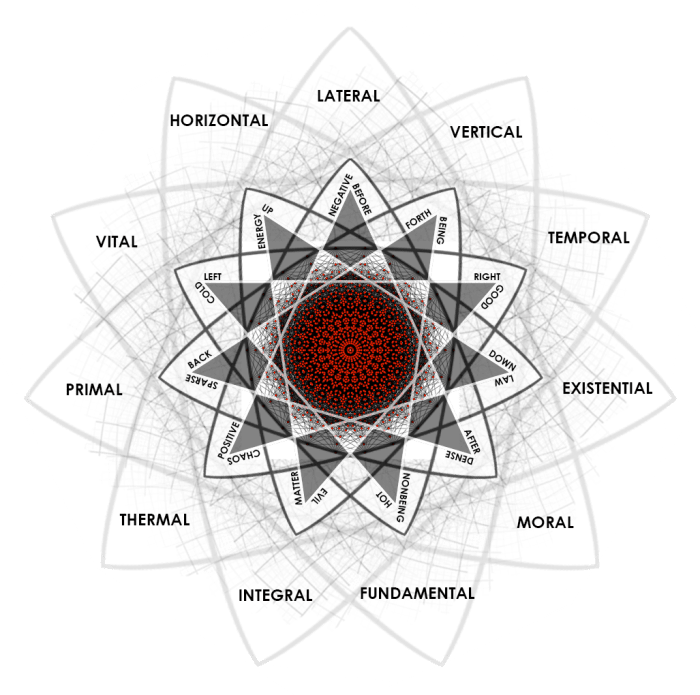
Sages categorize the eleven dimensions into three general groups: three Small Dimensions (Integral, Thermal, and Primal); five Middle Dimensions (Vital, Horizontal, Lateral, Vertical, and Temporal); and three Large Dimensions (Existential, Moral, and Fundamental).
By combining these 11 dimensions into a single manifold, sages have significantly simplified a large number of theories, as well as described in a more complete way the workings of the universe at both the super-galactic (astral, spiritual) and sub-quantum (ethereal, elemental) levels.
Mathematically, the known universe is a manifold consisting of “events” which are described by a coordinate system. In the known universe, a coordinate grid that spans the 11 dimensions locates events (physical situations or occurrences) at a specific point in the fabric of the universe, rather than merely points in 3D space. In this way, the coordinates can specify why, where, what, which, and when events occur within the weave of the cosmos. This unified theory of the known universe is known to scholars and sages as Manifold Theory.
Mortal minds have difficulty visualizing higher or lower dimensions because sometimes we only are aware of ourselves moving in one temporal and three spatial dimensions; but, we also move through, and thus our minds may detect, changes in energy, temperature, pressure, and charge. These facets make up the so-called “physical dimensions”. So too, we move through, and our minds detect, “spiritual dimensions” of consciousness, ethics, and probability.
The cosmos can be visualized by picturing a ribbon, representing the three spatial dimensions, at the smallest scale on one end, and the largest scale at the other. The two-dimensional Positive and Negative Planes, bound by the Vital and Primal dimensions, interact with our cosmic ribbon, but lie outside of it, for the purpose of this model. The Physical Plane, in the Vital and Temporal dimensions, is where we live. The three-dimensional Elemental Planes exist in the small, tightly wound Integral, Thermal, and Primal Dimensions. The Spiritual Planes exist in the immense Existential, Moral, and Fundamental Dimensions. From the Physical Plane, one may travel to the Elemental Planes, via the Primal Dimension, through the Ethereal Plane; or to the Spiritual Planes, via the Existential Dimension, through the Astral Plane.
The universe is all that exists, from deep within to way beyond; the mundane to the sublime; the unique to the ubiquitous; the real to the imagined; the sub-atomic to the super-astronomic. The fabric of reality contains everything in the universe within a complex matrix of eleven interwoven dimensions. These dimensions are categorized into three basic groups: The Small Dimensions (Integral, Thermal, and Primal); The Middle Dimensions (Vital, Horizontal, Lateral, Vertical, and Temporal); and The Large Dimensions (Existential, Moral, and Fundamental).
Every point and event in the universe exists simultaneously within each of these interwoven dimensions, which stretch like a rainbow in an unbroken continuum across seventy orders of magnitude: from the smallest scale (1 x 10–35 meters) to the largest (1 x 1035 meters). Along this vast cosmic spectrum, there emerge five distinct hyper-planar regions: an Elemental Plane, an Ethereal Plane, a Physical Plane, an Astral Plane, and a Spiritual Plane. Each of these planes present three-dimensional spatial realms (with wildly different environmental conditions) in which myriad beings, from the great universal Powers and Forces to common mortals and other trivial agents, exist and act upon the world and one another.
The Small Dimensions
As you might guess, strings that vibrate in the smallest dimensions define the Small Dimensions. The Integral Dimension determines substantiality at the sub-atomic level. Strings in this dimension determine states of matter: solid, liquid, vapour, plasma, and other even more exotic configurations.
The Thermal Dimension determines temperature at the sub-atomic level. Strings in this dimension determine how hot, cold, or otherwise any part of the universe might be. The particular character of the Thermal and Integral Dimensions together characterize nature of the Elemental Planes.
The Primal Dimension determines the sub-atomic intensity of matter and energy. Strings vibrating in this dimension define the relative nature of materials in the universe, and largely govern the environment of the Ethereal Plane.
The Middle Dimensions
The Middle Dimensions are those that we familiarly experience everyday on the Physical Plane. The Vital Dimension determines positive and negative charge at the sub-molecular level, imbuing parts of the universe with life and spirit at one end, or demise and undeath at the other.
The Horizontal, Lateral, and Vertical Dimensions, familiar to us as the three dimensions of space, permeate the universe, giving shape to directions back and forth, left and right, up and down, otherwise known as length, width, depth, etc…
The Temporal Dimension is also familiar in our experience of the Physical Plane, as time seems to move from before to after at a steady pace. Time can be compressed, moving quickly at smaller scales, or stretched, moving slowly at larger scales.
The Large Dimensions
The Large Dimensions still effect the universe on every level, but they especially characterize the universe at scales beyond our normal sensory perception. The Existential Dimension dictates the gravitas of all that is knowable, from the infinitesimal to the infinite, and to a large degree governs the structure of the Astral Plane.
The Moral Dimension determines the nature of the soul, from ultimate good to ultimate evil. Though much of the universe is invariably neutral, there are some events and agents that are inherently good or evil, and others who have the ability to choose their own moral alignment through the exercise of free spirit.
The Fundamental Dimension dictates the potential of all things, whether affected by orderly law, or random chaos. Again, though much of the universe is invariably neutral, there are some events and agents that are inherently chaotic or lawful, and others who have the ability to choose their own philosophical alignment through an exercise of free will.
Together, the Moral and Fundamental Dimensions describe an individual’s spiritual alignment, and characterize all aspects of existence within the Spiritual Plane.
 The Ages of Urthe