
The Age of Beginning—The Age of Elements—The Age of the Virgin
The First Age saw the birth of the eleven-dimensional cosmos, and the creation of one hundred twenty alchemical elements, the building blocks of all the material features of the Physical Plane.
12,900 BCE
Innumerable one-dimensional strings, each a mere 1 × 10-36 meters in length, vibrate in the Primal Dimension, creating the ethereal ‘foam’ of the deep end of the Ethereal Plane.
Vibrations resonate in the Integral and Thermal Dimensions, forming the elementary whirling torus particles of the Elemental Plane.

12,800 BCE: Elementary Particles, and the Cardinal Powers
The Elemental Forces within sub-planes interact to produce larger quantum particles, which emerge from the Elemental Plane, travelling through the bordering Ethereal Plane, ultimately appearing in our Physical Plane.
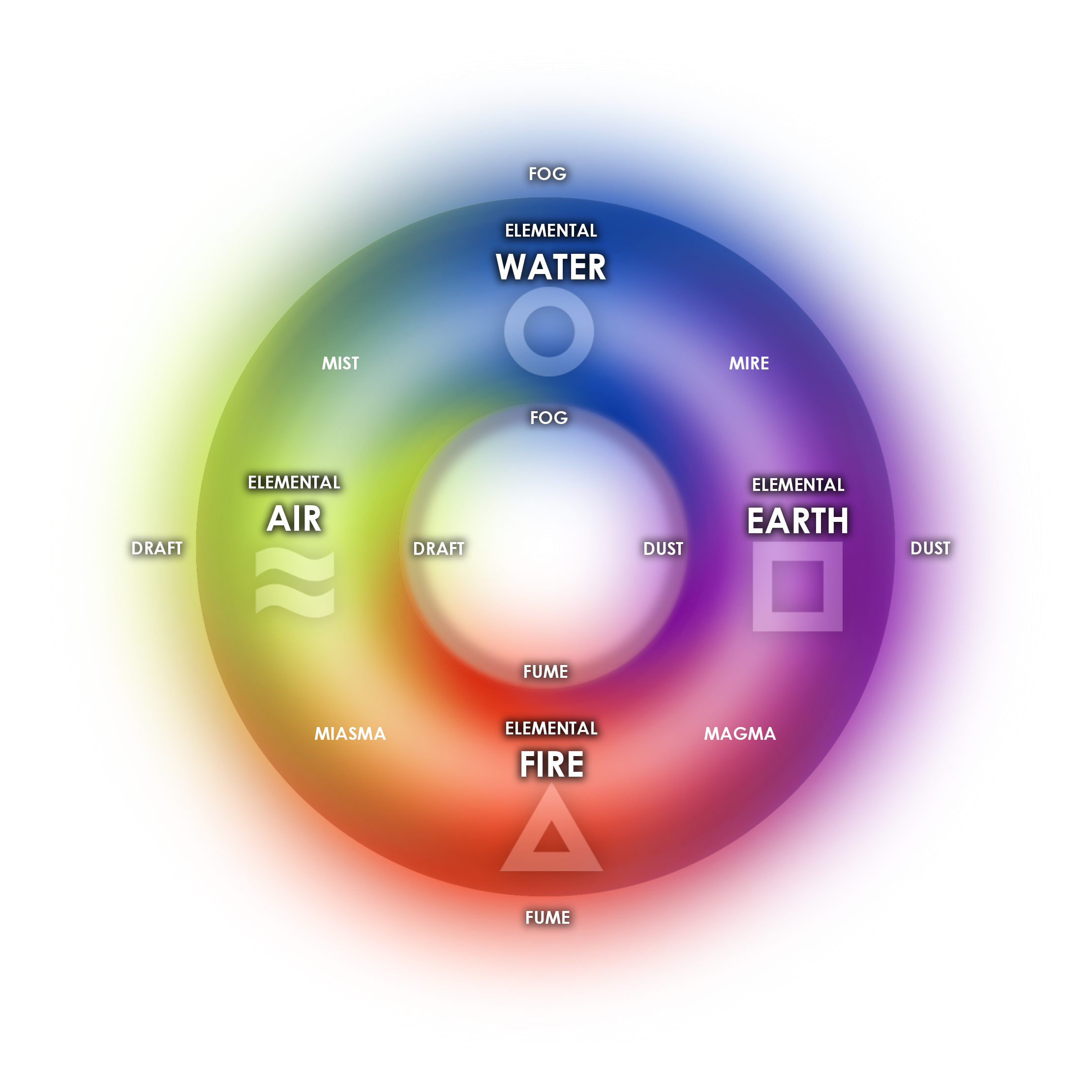
The Elemental Plane’s Dimensions Three:
Integral, Primal, Thermal: X, Y, Z.
Pure Energy, or Matter concentrate.
Pure Cold, and Heat. Sublime, or condensate.
And thus, the Elemental Planes are trussed,
Between the Fog, and Fume, and Draft, and Dust.
Between Miasma, Magma, Mist, and Mire,
Pure Realms of Air… and Water… Earth… and Fire.
Pure Elemental Fire dims and glows,
Pure Elemental Earth both fell and rose,
Pure Elemental Water ebbs and flows,
Pure Elemental Air unbounded blows.
12,700 BCE: Hydrogen and Helion
The first atoms of hydrogen, then helion, emerge and spread throughout the Vertical, Horizontal, and Lateral Dimensions as material alchemical elements form.
Sub-natural Elemental Forces
undergird all alchemical sources.
Urthe’s alchemical Elemental Plane,
One Hundred Twenty names in this domain.
Hydrogena, the daughter of Water;
and Helios, the son that Fire did sire;
12,600 BCE: Lithium and Beryllium
Alchemical elemental clouds, called nebulae, have already begun to materialize, and as they grow more dense, scattered atoms of lithium and beryllium appear within them for the first time.
and Lithos, to whom Earth had given birth;
and Beryllia, the heiress of Air;
coupled and coupled and coupled again,
One Hundred Twenty names in this domain.
12,500 BCE: The Basic Elements
The genealogy continues in full as the first thirty elements take their names and their places within the domain.
Earth mixed with air brought us Boros, the night.
Fire mixed with Earth brought Carbos, the mighty.
Fire with Air: Nitrogena, the naughty.
Water, Air: Oxygena, the haughty.
Water with Earth, Fluorina, the flighty.
Water and fire gave us Neos, the light.
These in turn coupled, and coupled again.
One Hundred Twenty names in this domain,
Sodos, Magnesos, and Alumos
Silicos, Phosphoros, and Sulfuros
Chlorina, Argos, Potassos, Calcos…
Urthe’s alchemical Elemental Plane.
12,400 BCE: The Primordial Gas Nebulae
These elemental clouds propagate throughout the cosmos, vast and slow-turning, the raw material from which every subsequent star, and every subsequent element beyond the first thirty, will eventually be drawn.
12,300 BCE: The Atypic Elements
Within the densest folds of the propagating nebulae, the next thirty elements take shape, rarer already than the basic thirty that came before them, though still born of the same coupling process that produced their simpler kin.
12,200 BCE: The First Stars
The first stars are born, creating yet more elements. The first atoms of boron, carbon, nitrogen, and oxygen appear throughout the cosmos in earnest, no longer scattered traces but true stellar products.
12,100 BCE: The Attic Elements
In the fire of these first stellar generations, the third thirty elements emerge, heavier and stranger still, crowned by the earliest of the mantic metals.
12,000 BCE: The First Galaxies
By this age, larger stars have formed, bringing into existence even more elements still. Great collections of stars begin to aggregate around enormous black holes, and the first true galaxies take shape from what had until now been only scattered stellar nurseries.
11,900 BCE: The Exotic Elements
The death of the very first stars, and the supernovae some of the largest among them produce, forges the final thirty elements, the rarest and most legendary the cosmos will ever know, closing the domain’s full hundred and twenty at last.
11,800 BCE: The First Asteroids
Asteroids and other rocky bodies begin to populate the cosmos, the first solid matter of any real size to condense from the debris the newborn galaxies leave scattered in their wake.
11,700 BCE: Complex Elemental Compounds
With the full domain of elements now in existence, and solid rocky bodies to host them, the first true compounds begin to form, matter no longer merely elemental but combined, layered, and structured for the first time.
11,600 BCE: The First Comets
Propelled by detonations, or thrust by collisions, or drawn by gravitational pull, comets now join the asteroids, travelling without purpose throughout the cosmos.
11,500 BCE: The Silver Wheel Galaxy
The Silver Wheel Galaxy takes shape, one great spiral among countless others, its arms slowly gathering the gas, dust, and rocky debris that will, in time, give rise to a single star of particular consequence.
11,300 BCE: A Star Ignites, and Its Family Gathers
Within the turning arms of the Silver Wheel, gravity draws enough gas and dust into a single dense point to ignite a new star. Around it, the same slow accretion that first built the asteroids and comets now begins to build worlds, rocky matter drawn inexorably into orbit.
11,100 BCE: Solus
The star Solus, one of many within the Silver Wheel, has by now attracted enough rocky matter to complete the formation of its planets: the Inner Planets, Icarus, Nimbus, Urthe, and Ferrus, with a ring of asteroids dividing them from the Outer Planets, Imperius, Dominus, Cronos, and Hera.

11,000 BCE: The Clash of the Elements

Air raises nebulae: gas worlds commix, and Fire fuels the stars, as flame worlds ignite. Earth builds the asteroids: rock worlds accrete, and Water bears comets: sea worlds condense. Rarely in space do such bodies collide: but when they do, neither one will abide. Yet sometimes, in a billion destructions, Forces, combined, make hybrid constructions.
Fire rushes in to claim the creation of a new world of flame. Earth counters, and contains Fire within a lodestone shell. The shell proves too thin, as it melts, sinks and congeals into a molten ball in the belly of the flames. Earth doubles its efforts, packing on ore, thick and heavy, struggling and shifting over an unquenchable Fire below. Earth keeps Fire pinned down, but Fire continues to squirm and buck with violent volcanic outbursts. Water, treacherously sensing an opportunity for surprise dominance, rushes to cover the sprawled Earth. Water rises and falls, pulls and pushes, but discovers that Earth is much too rough to completely subdue. Water lays low and holds its ground, succeeding in covering most of the new world’s hot, rocky surface; however, a large patch of Earth still retains prominence. Invisibly, Air rolls over the world, here slow and silent, there rushing and roaring, always acting as an aloof instigator: stirring up Water, looking down upon Earth, and snuffing or stoking Fire.
Four Forces—Fire, Water, Air, and Earth—
battle to stalemate and make the world, Urthe.
10,750 BCE: Urthe
Beyond the stars, the nebulae, the galaxy clusters, gigaparsecs past the observable universe, towards the infinite direction in the Existential Dimension, lies the Astral Plane. Further still, beyond the Astral Plane, spanning the Moral and Fundamental Dimensions, lies the Spiritual Plane. The Cardinal Powers, Vita, Fortuna, Mortem, Aequitas, and Magica, first take on the shape and portfolio by which all later ages will know them.
Fundamental, Moral, Existential skeins
weave three dimensional Spiritual Planes.
From Chaos to Law, from Evil to Good,
Souls tasked to tell if they did what they should,
then finally rest in the sempiternal:
The Seven Heavenly Realms Supernal?
Or, perhaps, Three Hereafters Eternal?
Or, gods forbid, Seven Hells Infernal?

